 Peptide Grading
 United States
01
GLP-1 receptor signaling
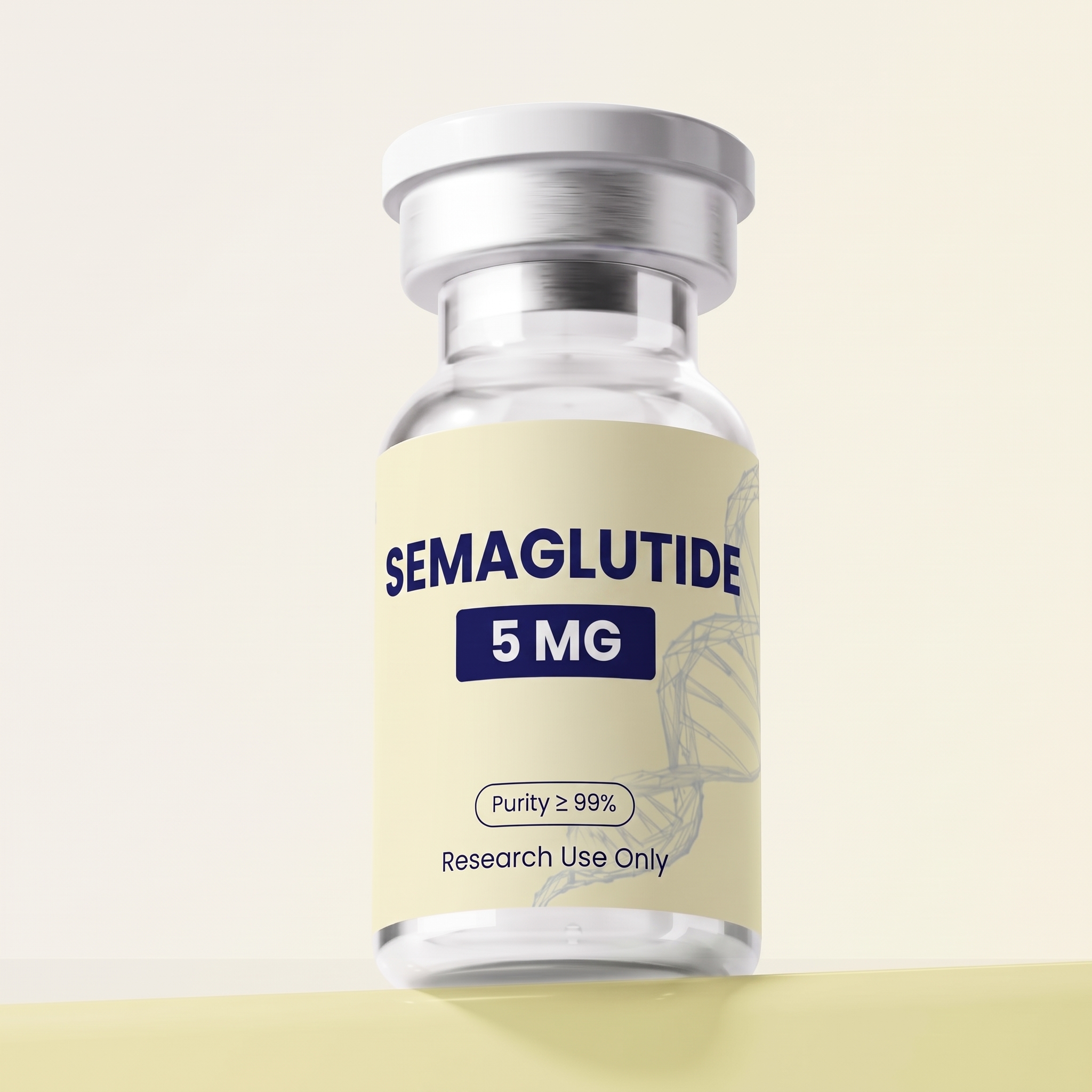
Research peptide
From
$30.00
Vendors
7
Lab tested
8 COAs
Key benefits
Semaglutide started as something your own gut already makes. GLP-1 nudges the pancreas to release insulin and tells your brain you've eaten enough, and then it's gone in a couple of minutes. Not much use as a drug. So Novo Nordisk kept editing the molecule until it lasted about a week. That version ended up in Ozempic, Rybelsus, and Wegovy. The first two are for type 2 diabetes; Wegovy is the weight one, and you can't get any of them without a prescription.
Most compounds on a research-peptide site have no approved use at all. Semaglutide does, and that changes how everything below should be read. Peptide Grading lists research-labeled semaglutide listings so vendors, vial sizes, price per mg, and COA documents sit side by side. A listing here is not the same thing as the prescription product.
Typical dose
0.25-2.4mg weekly
Weekly, increase every 4 weeks
Route
Subcutaneous weekly
Inject once weekly on the same day each week. Can be taken with or without food.
Cycle
16–20+ weeks; ongoing for weight management
Typical duration
Storage
2-8°C
Follow vendor guidance
Marketplace
Prices per size, coupon codes, lab reports and shipping.
| Vendor | Price | Coupon | Lab test | Shipping | |
|---|---|---|---|---|---|
$30.00$40.00 Lowest price−25%$6.00/mg | 2 COAs | 1-5 days
| Buy | ||
PRPEPS 10 mg | $40.00 $4.00/mg | Not on file | 2 days
| Buy | |
Vertex Labs 10 mg | $44.10$49.00 −10%$4.41/mg | 2 COAs | 3 days
| Buy | |
bioinfinity 5 mg | $45.00 $9.00/mg | 1 COA | 3–5 days
| Buy | |
Trulab Peptides 5 mg | $59.00 $11.80/mg | 1 COA | 2–5 days
| Buy | |
$60.00 $12.00/mg | 2 COAs | 1-2 days
| Buy | ||
Prime Pep Solutions 10 mg | $69.99 $7.00/mg | Not on file | 1–3 days
| Buy |
On paper, it's 31 amino acids, and about 94% of that matches human GLP-1. The differences are small, but they do the work. At position 8, alanine is swapped for aminoisobutyric acid, so DPP-4, the enzyme that normally chops GLP-1 up within minutes, can't cut it. Position 34 gets arginine instead of lysine. Then there's a fatty diacid chain sitting on lysine 26, which grabs onto albumin in the blood. That last change is what really slows clearance, and honestly it's the reason a once-weekly schedule works at all.
Compound
Semaglutide
Native GLP-1 is useful biologically and a poor drug because its half-life is measured in minutes. The two changes above are what turned it into something taken once a week. Researchers use semaglutide to study GLP-1 receptor signaling, appetite regulation, insulin secretion, and how long-acting analogues behave compared with the natural hormone.
One detail that matters if you're reading vendor pages: the approved drugs contain semaglutide base. Some products on the market are made from salt forms such as semaglutide sodium or acetate. The FDA has said those are different active ingredients from the approved ones.
01
GLP-1 receptor signaling
02
Glucose control and insulin secretion
03
Appetite and energy balance
04
Cardiovascular and kidney outcomes (in clinical programs on the approved drugs)
05
Fatty liver disease
06
Peptide stability and delivery, including the oral tablet form
| Compound | Main structural feature | Length | Key distinction |
|---|---|---|---|
| Semaglutide | GLP-1 analogue, C18 diacid | Weekly | Approved for diabetes and weight management |
| Liraglutide | GLP-1 analogue, C16 fatty acid | Daily | Earlier Novo Nordisk drug, shorter-acting |
| Tirzepatide | Dual GIP and GLP-1 agonist | Weekly | Acts on two receptors |
| Native GLP-1 | Unmodified hormone | None | Half-life of minutes |
These aren't interchangeable. Different receptor profiles, trial programs, and approval histories.
The human evidence is large, but it belongs to the approved products. The SUSTAIN and STEP programs covered diabetes and weight, SELECT looked at cardiovascular outcomes (published in the New England Journal of Medicine in 2023), and FLOW studied kidney disease. All of them used Novo Nordisk's pharmaceutical product, made under controlled manufacturing and given under medical supervision.
That is the line I'd draw clearly. None of those results tell you what's in a lyophilized vial from a research vendor.
The approved labels list nausea, vomiting, diarrhea, and constipation as common side effects, along with a boxed warning for thyroid C-cell tumors (seen in rodents) and cautions around pancreatitis and gallbladder disease.
On compounding, the FDA has received adverse event reports linked to compounded semaglutide, including dosing errors, and has warned against salt-form versions. State pharmacy boards have also said "research use only" material can't be used for compounding. The same goes for the sale of research-labeled GLP-1 products directly to consumers: the FDA has issued warnings to companies doing that.
A "research use only" label means in vitro lab work. It isn't a legal workaround, and it says nothing about quality.
Semaglutide is not prohibited under WADA’s 2026 Prohibited List, and GLP-1 drugs remain permitted under the newly published 2027 list. It is included in WADA’s Monitoring Program, meaning its use is tracked without sanctions; athletes should still verify current anti-doping rules before use.
Research reference note
Go through the available listings one at a time. Read the [COA](/coas), check the salt form and the lot number, and look at the price per mg last. At [Peptide Grading](#vendor-listings), you can compare suppliers by specifications, documentation, pricing, and COA details in one place.
FAQ
No. The approved drugs are made and tested to pharmaceutical standards. Research vials get no FDA review of identity, purity, sterility or quantity.